
by Daria Kniese
THE FASHION DECISION ECOSYSTEM™
Executive Essay No. 03
„The greatest inefficiency in a big company isn’t inside a department. It’s between them.“
Daria K.
Walk into almost any fashion company and you’ll find talented people making intelligent decisions.
Design creates products customers will love. Buyers negotiate better supplier terms. Merchandisers protect margin. Planners improve forecast accuracy. Sourcing reduces production risk. Logistics optimizes distribution. Marketing drives demand. Finance safeguards profitability.
Every function has capable people, clear objectives and well-defined KPIs. Yet many fashion businesses still underperform. Not because people make poor decisions. But because they make good decisions against the wrong objective. That distinction changes everything.
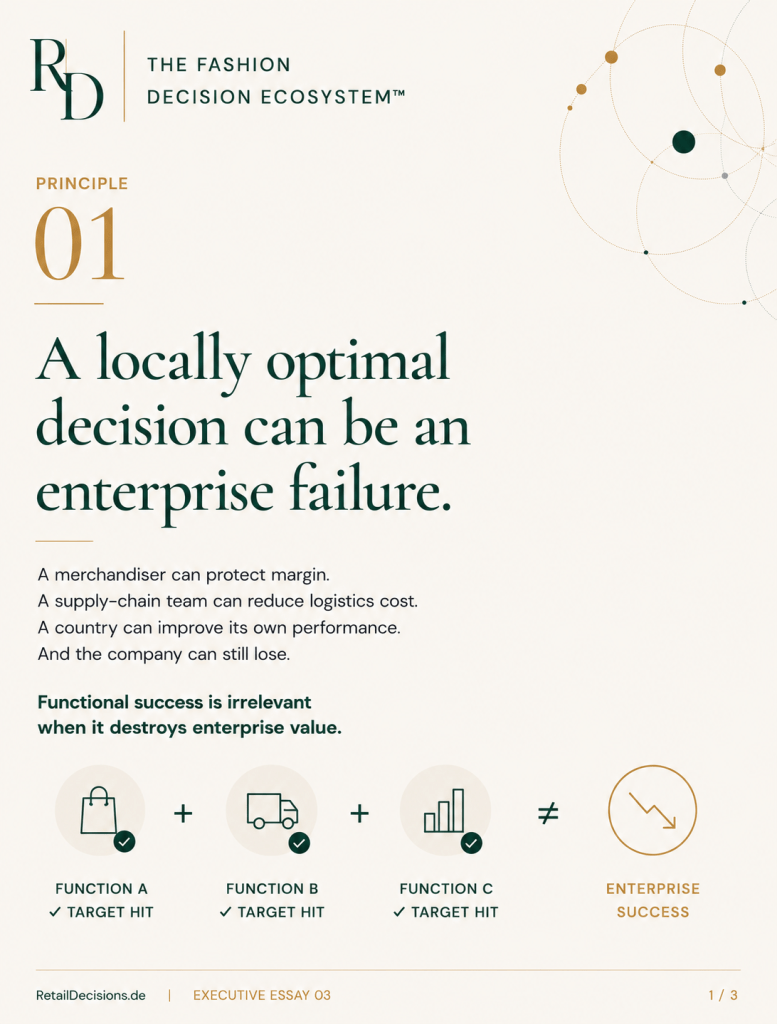
Most organizations are designed to optimize functional performance. Every department is measured by its own scorecard, rewarded for its own achievements and expected to improve its own KPIs. On paper, this seems entirely logical. In reality, it often creates a business where every team succeeds individually while the company underperforms collectively.
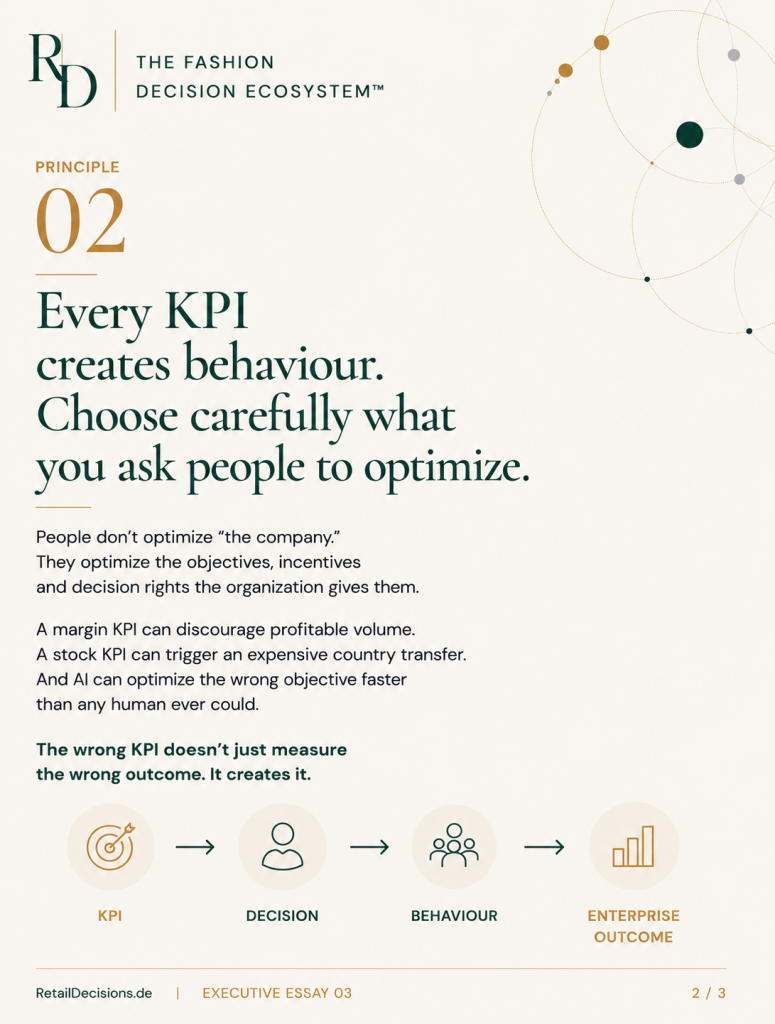
People optimize exactly what they are measured on. The problem is that customers never experience individual departments. They experience one company. One product. One price. One delivery. One brand.

„Most organizations don’t have a collaboration problem. They have an incentive problem.“
The Hidden Cost of Local Optimization
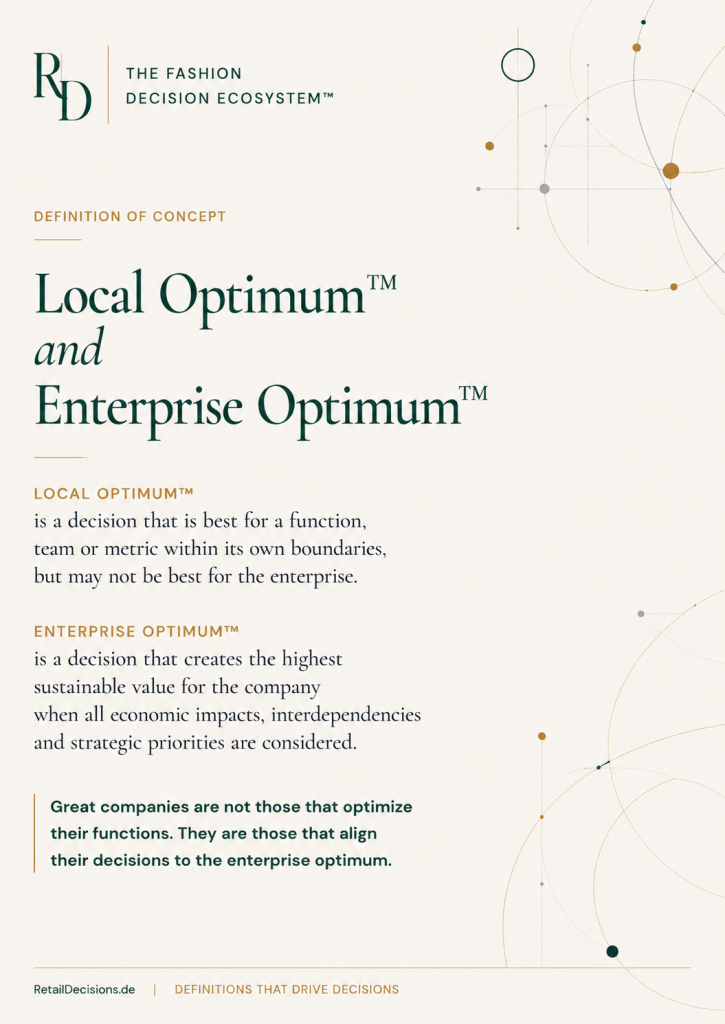
One observation has followed me throughout software implementations, process transformations and executive discussions. Departments rarely make irrational decisions. In fact, most decisions are perfectly rational. The problem is that they are rational locally, not commercially. I think of this as the difference between a Local Optimum and an Enterprise Optimum. A Local Optimum is the best possible outcome for one department. An Enterprise Optimum is the best possible outcome for the business as a whole. Those two outcomes are often very different.
Consider a merchandiser whose objective is to protect product margin. The KPI is clear. Preserve margin wherever possible. Now imagine a situation where reducing the margin by two percentage points would significantly increase sales volume and ultimately generate substantially higher gross profit for the company. Protecting margin satisfies the departmental KPI. Improving gross profit creates greater value for the entirety of the business.
Imagine excess inventory sitting in one country while demand exists in another. Moving the stock appears to be the obvious solution. Availability improves, markdown risk decreases and local inventory targets are achieved.
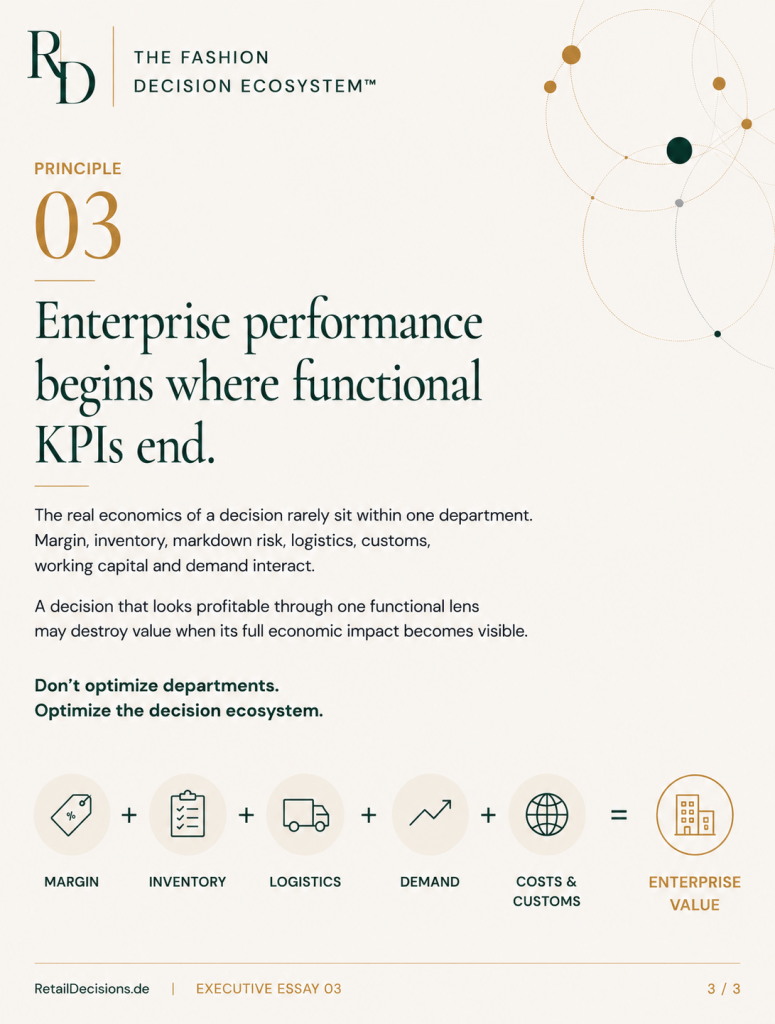
But what happens next? Transport costs increase. Customs duties are eventually incurred. Additional handling costs appear. Lead times become longer. The fully loaded product cost rises. A decision that initially looked commercially sensible quietly destroys value once the entire cost system is considered.
Again, nobody made a poor decision. The decision was simply incomplete. It optimized a departmental KPI rather than the commercial performance of the enterprise.
The Invisible Organization
Most executives manage the organization shown on the organizational chart. Departments. Reporting lines. Functions. Responsibilities. But every successful business operates through another organization that never appears on paper. The invisible organization of connected decisions. Pricing influences design, merchandising & buying. Merchandising & buying influences sourcing. Sourcing influences logistics. Sustainability influences sourcing. Logistics influences availability. Availability influences markdowns. Markdowns influence profitability. No department owns this chain. Yet every department influences it. Customers don’t buy from individual functions. They buy the accumulated outcome of hundreds of interconnected decisions. This invisible organization determines commercial success far more than the visible one.
A Different Definition of Leadership
Leadership is often described as setting strategy, managing performance or delivering transformation. I believe its primary responsibility is something different. Leadership exists to align decisions around a common objective. That sounds obvious. Yet many executive meetings still revolve around functional performance.
Buying presents buying KPIs.
Planning presents planning KPIs.
Logistics presents logistics KPIs.
Finance presents finance KPIs.
The company becomes a collection of successful presentations. But one question is often missing. Did all of these successful decisions create more value for the business? That is the only KPI that ultimately matters.
Every commercial decision should be evaluated not only by whether it improves a department’s performance, but whether it increases enterprise value. When organizations reward local optimization, they should never be surprised by global inefficiency within their business.
Looking Beyond the Dashboard
The longer I work with fashion organizations, the more convinced I become that transformation is not primarily about software, processes or technology.
It is about incentives. People optimize exactly what they are measured on. If KPIs reward departmental success, departments will optimize departments. If incentives reward enterprise performance, decisions begin to change naturally.
This is the future competitive advantage of every successful business.
Even the most advanced technology, powered by increasingly sophisticated AI, will fail to deliver sustainable profitability if it is built upon the wrong objectives, incentives and KPIs. AI can optimize decisions at unprecedented speed and scale, but it cannot distinguish between local and enterprise value if the organization has defined success incorrectly.
Competitive advantage will belong to organizations that optimize across the entire decision ecosystem rather than within functional boundaries. They establish a common strategic direction, align objectives from the executive team to operational teams, and ensure that every KPI contributes to the same commercial outcome.
Technology amplifies decisions. But strategy precedes it & determines whether those decisions create value.



 RetailDecisions.de
Hinterlasse einen Kommentar