
by Daria Kniese
THE FASHION DECISION ECOSYSTEM™
Executive Essay No. 01
Why Fashion Companies Don’t Have a Pricing Problem. They Have a Decision Problem.
Last Tuesday, somewhere in Europe, a merchandising team gathered around a professionally prepared pricing deck. Thirty-two slides. Four dashboards. Three forecasts. One heated discussion. Someone confidently declared: „Customers simply aren’t willing to pay more this season.“ Heads nodded. The meeting moved on. The price was approved. The collection launched. Six months later, millions in margin quietly disappeared. No alarm sounded. No system flashed red. No one deliberately made a bad decision. Yet the business paid for one.
The uncomfortable truth is this: Fashion companies rarely lose margin because people are unintelligent. They lose margin because intelligent people make decisions with incomplete information. There is a difference. A very expensive one.
The Myth of „Pricing“
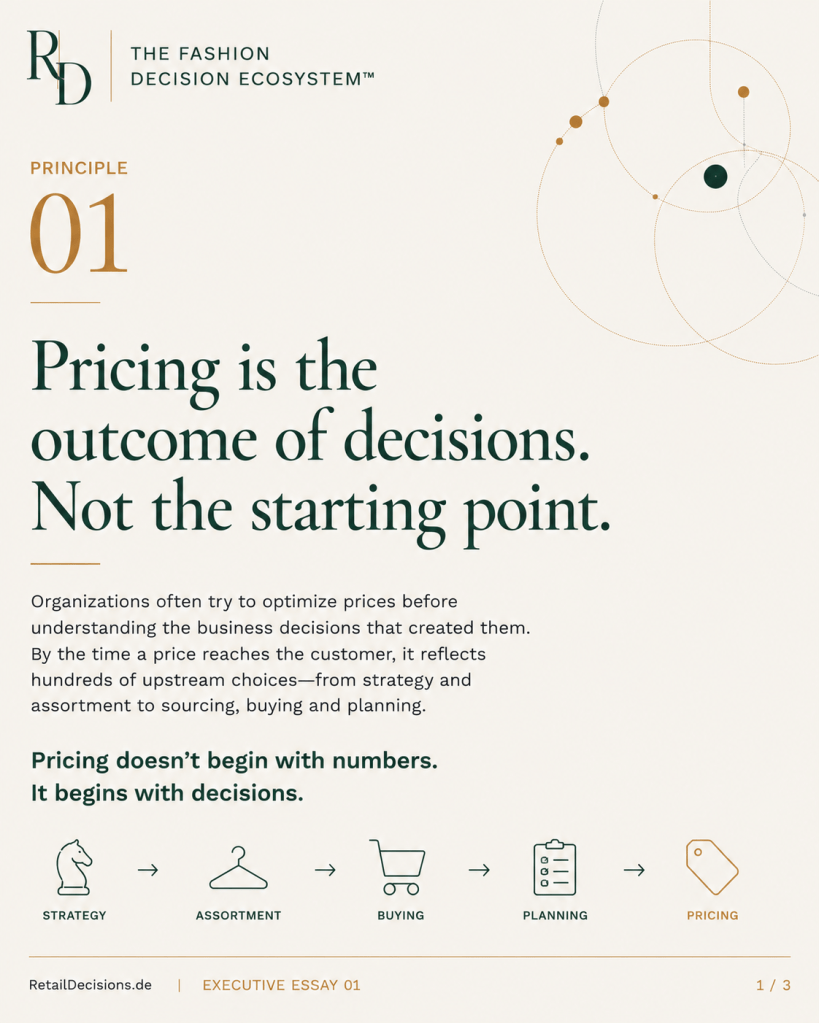
I’ve spent years working alongside merchandising leaders, product teams and transformation programmes on both sides as an IT software sales executive, IT consultant & Project Manager. Whenever margins deteriorate, pricing is often the first suspect to blame. „Our prices are wrong.“ But pricing is usually the last domino to fall.
Long before a customer ever sees a €79.99 price tag, hundreds of upstream decisions have already shaped whether that number can ever be profitable. A delayed product launch. A supplier that quietly increased costs. An oversized assortment. Poor size ratios. Late design approvals. A markdown calendar based on last year’s weather expectations. Pricing simply inherits those decisions.
It’s like blaming the scoreboard for losing the match.
The Meeting Nobody Has
Imagine walking into your weekly trading meeting. Instead of another report or dashboard, an AI assistant opens with: „Good morning. Before we discuss pricing, there are three decisions costing you approximately €18.4 million this season.“ Silence.
Then it continues. „Women’s knitwear has 23% more assortment overlap than comparable retailers.“ „Your premium pricing architecture has a missing price tier between €89 and €109.“
„Seventeen suppliers account for 71% of launch delays, which will reduce full-price sell-through by an estimated 4.2%.“
Now that’s a meeting worth attending.
We Don’t Need More Reports or Dashboards
Retail has become exceptionally good at collecting data. Sales data. Inventory data. Competitor prices. Customer behaviour through loyalty programs. Supplier performance. Weather. Returns. Social sentiment.
The problem isn’t the absence of information. It’s the absence of interpretation. Every executive has seen dashboards showing what happened. Far fewer have systems that explain why it happened. Fewer still have tools suggesting what to do next.
The Real Competitive Advantage
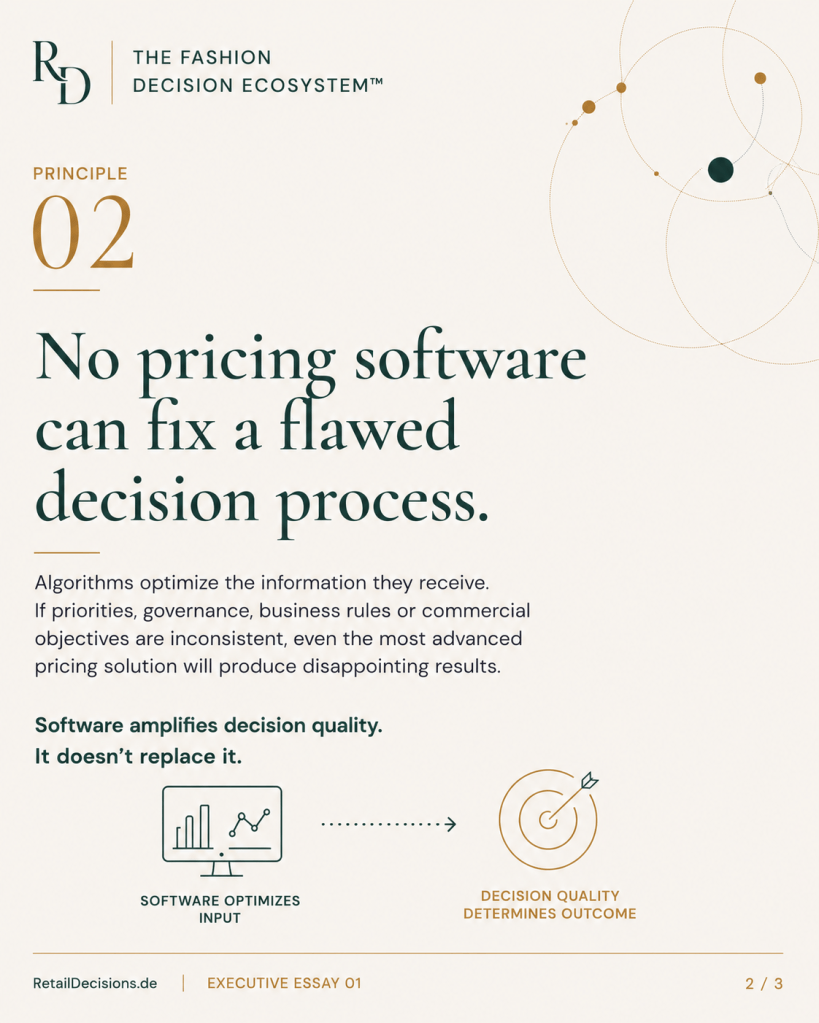
For years, retailers have invested heavily in software. PLM. ERP. Planning. Pricing. Allocation. Forecasting. Each system solves a specific problem exceptionally well. Yet every Monday morning, senior leaders still gather in meeting rooms asking remarkably human questions:
„What are we missing?“
„What should we do?“
„Which decisions will have the biggest impact?“
Those questions don’t belong to software. They belong to leadership. But leadership deserves better decision support than spreadsheets stitched together at midnight from various angles of perspective buying, planning, allocation, sales.
Here’s the Twist
The companies that will outperform over the next decade won’t necessarily own the best pricing software. Or the biggest AI models. Or the most dashboards. They will be the organisations that shorten the distance between information and decision. Because competitive advantage is no longer created by having more data. It’s created by making better decisions faster than everyone else.
That is a very different game.
A Question Worth Asking
The next time a pricing discussion starts with: „Should we reduce prices?“ Perhaps the better question is: „What decision, made six months ago, made this conversation inevitable?“
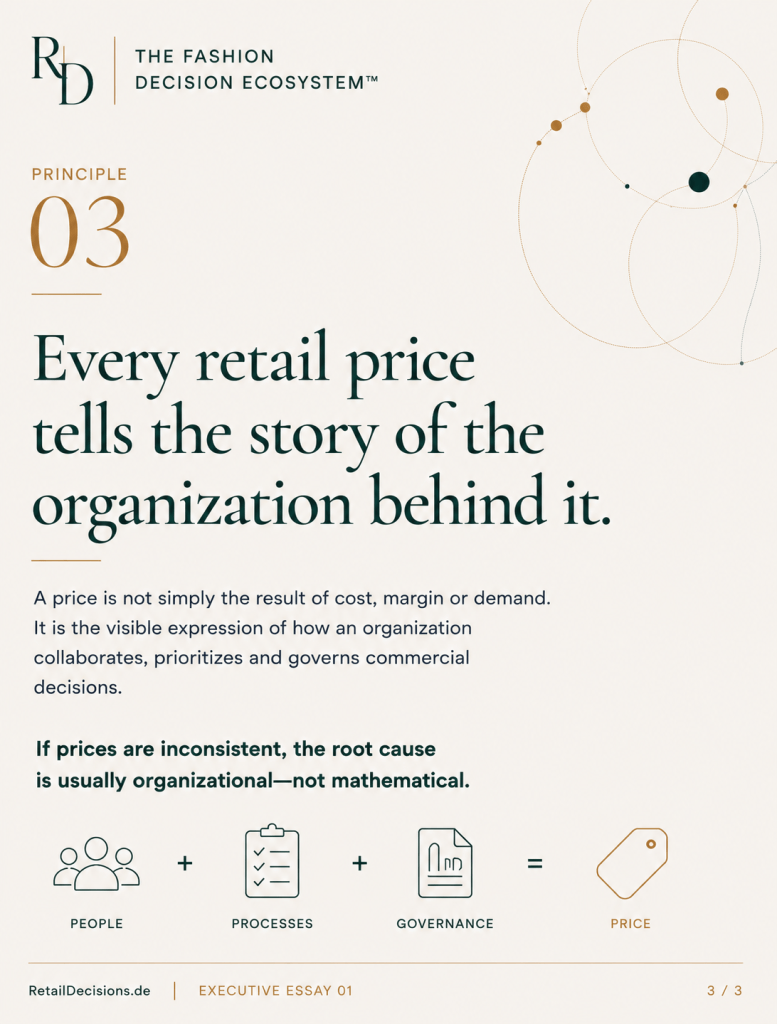
Because pricing doesn’t begin with a price tag. It begins with every decision that came before it. And perhaps that’s the biggest opportunity AI gives the fashion industry—not to replace decision-makers, but to help them see the decisions they’ve been missing all along.
The companies that recognise this first won’t just improve pricing. They’ll redefine how fashion businesses are run.


 RetailDecisions.de
Hinterlasse einen Kommentar